While winter remains the core business for most mountains, summer operations – from lift-served mountain biking to sightseeing and festivals – are becoming a significant source of revenue, pushing infrastructure once designed solely for skiing to operate through warmer months with new equipment configurations and extended hours.
From mountain biking to weddings
For operators, this expansion presents both opportunities and operational challenges. Karl Emond, customer service lead for Doppelmayr Canada, says the range of summer lift uses has grown steadily in recent years as resorts look for ways to maximize their investments.
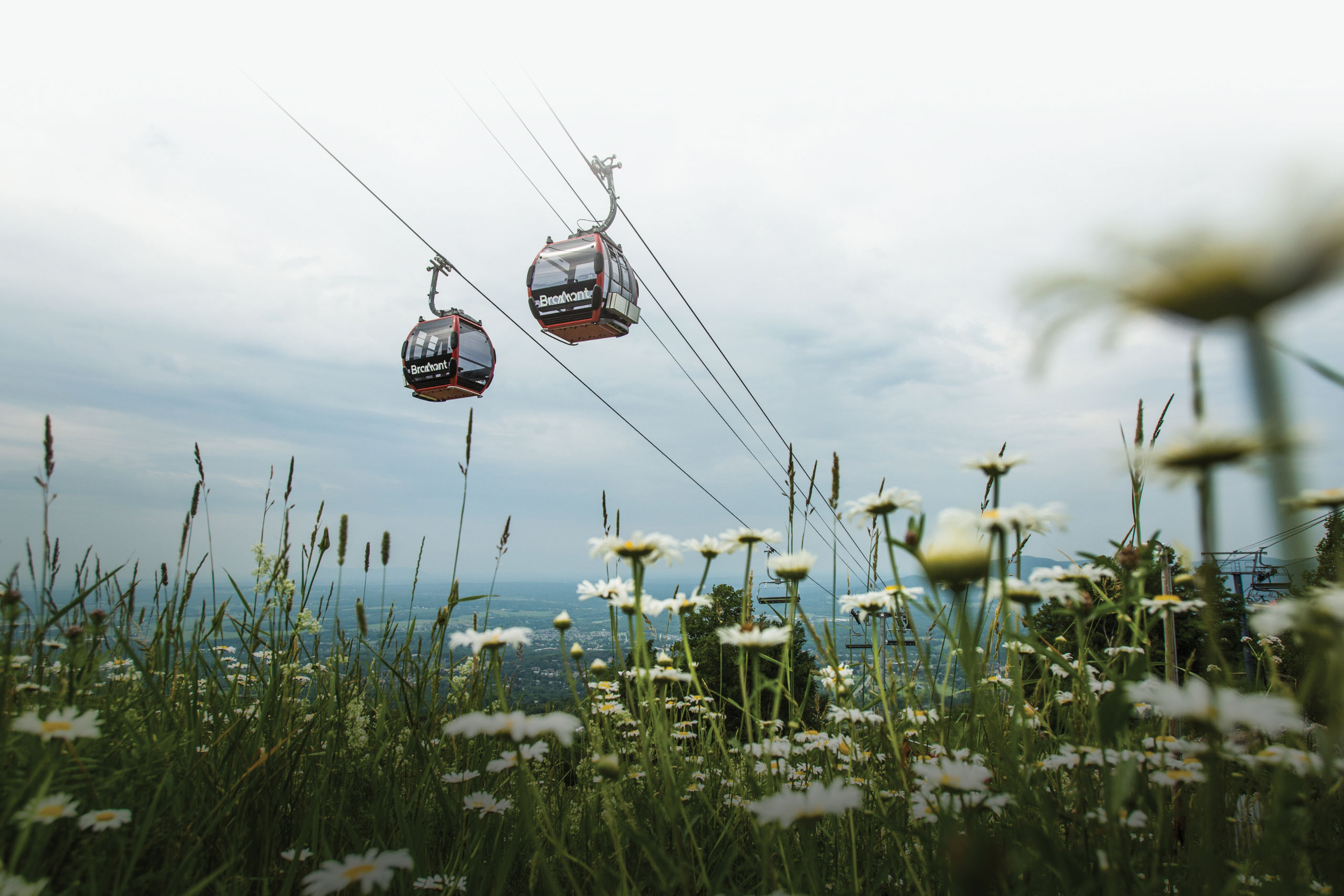
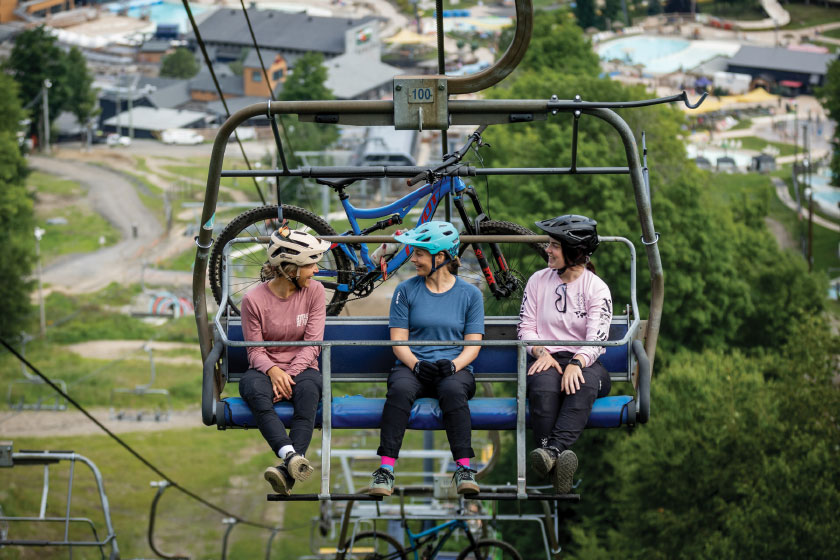
One of the most visible examples is lift-served mountain biking, which has become a major attraction at many resorts. To accommodate bikes, lifts often need to be modified. “Many options are available to carry sport equipment on a ropeway, ranging from dedicated bike racks to side hooks retrofitted on existing chairs, all the way to some gondola options as well,” Emond said.
Beyond biking, resorts are experimenting with a wide variety of activities designed to attract visitors during warmer months. “Some of our ski resorts in Eastern Canada also operate water parks in the summertime,” Emond said. “Their ski chairlifts can then be used to go from one pool to another, or to make it to the top of the mountain. Another great use of a ski lift is happening during the fall; our clients bring their guests up so that they can see the view, they can see the fall colors, and sometimes they will also have activities at the top.”
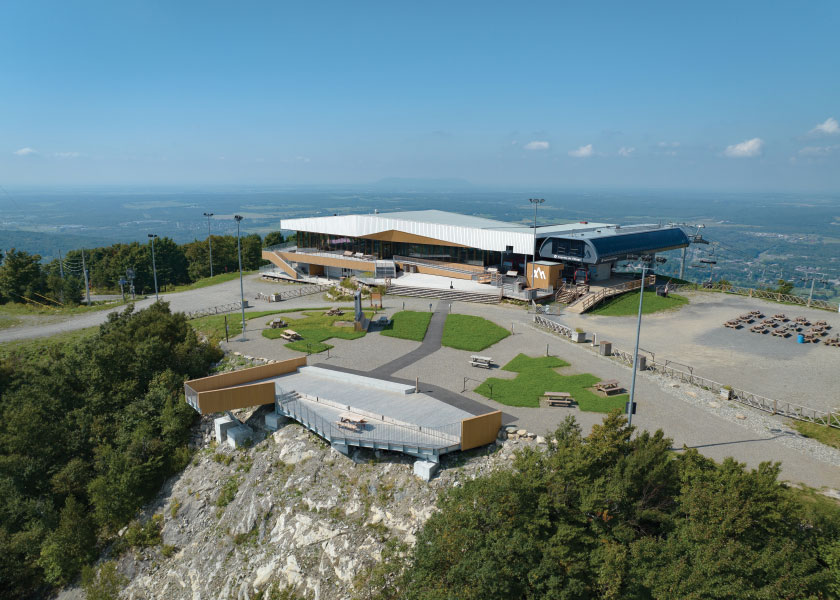
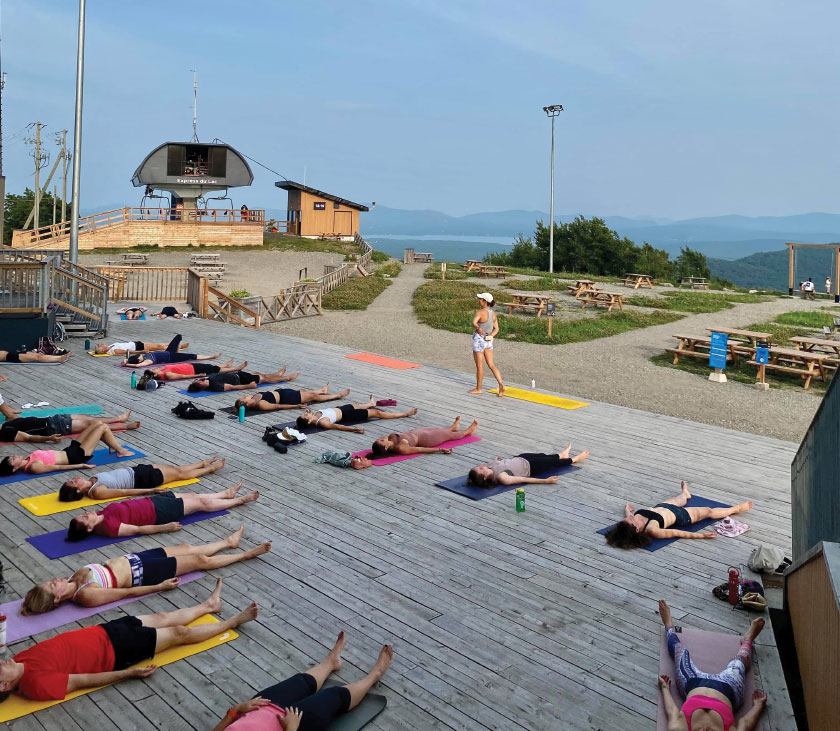
These events often include entertainment for families, which could include a live band, barbecue and different activities for kids, such as face painting. Some lifts operate primarily as sightseeing attractions, even outside traditional ski areas. “We also have other ropeway installations that are used to access points of interest, for example the Sea to Sky Gondola in Squamish, B.C. These destinations are not necessarily ski areas. They will bring guests to the top, where they can access the lounge, and experience the nice view,” Emond said.
He adds that more customers are using ski lifts in the summertime to host weddings. “Our clients can install a big tent or use an existing building to have ceremony at the top of the hill,” he said. Other concepts push the idea even further, such as mountain carting.
The challenge of limited maintenance windows
While these activities expand a resort’s appeal, they also complicate lift operations, particularly maintenance planning. “It’s a challenge for us because customers who are running winter operations and summer operations want to do the maintenance only in April, May and October,” Emond said.
The maintenance period, traditionally used for off-season work, are becoming increasingly compressed. As a result, manufacturers and service teams must coordinate closely with multiple resorts. “We have a significant demand for our mechanical, electrical, and hydraulic technicians during this period, so advance planning with all customers is essential to align all schedules,” he said.
Operational differences between summer and winter
Operationally, summer lift use can feel less urgent than winter operations, but it introduces its own technical considerations. “I would say that it’s less stressful in summertime because, let’s say, you have a lift down, you have a component that failed,” Emond said. “Well, it’s not cold outside when performing a rope [evacuation].”
However, higher temperatures can introduce mechanical challenges. When resorts retrofit lifts or add new uses, engineering considerations become critical. “If a customer wants to add bike racks or bike clips, we need to do an engineering study because as per the code, we need to comply with all the requirements, the swing clearances, the loads,” he said. “And we need to perform some acceptance tests to make sure that all codes are met, and that the overall ropeway is safe for public use.”
Core maintenance tasks during shutdown periods
Routine maintenance is essential, particularly during the short spring and fall shutdown periods. “There is the normal maintenance that needs to be done,” Emond said. “That means they will have to carry out their non-destructive testing (NDT). They will need to do their grips NDT. They will also need to inspect the carriers.
“The bull wheels need to be greased as well. On top of that, if we need to do some special work, such as bearing replacement on the bull wheel, or we need to repair the brushes on the electrical motor, that means that we need to bring a crane, remove the motor from the drive station and send it to a third party so that they can rewind the motor.”
Some components require major overhauls based on operating hours. “The gearbox also, there’s a maintenance schedule of operation, they need to replace the bearings and the seals (as per the manufacturer recommendations),” Emond said. In addition, cable replacements, communication lines and other major repairs must be carefully scheduled.
“If we need to replace the cable or the communication line, or anything, we need to do it on a really tight schedule for multiple customers at the same time,” Emond said.
Adjusting lift operations or summer guests
Summer operations require adjustments because now guests are off their skis and snowboards. They are walking passengers. Additionally, some resorts also reduce the number of carriers during summer sightseeing operations. “Since you are loading walking passengers on a fixed-grip chairlift, you need to operate on a slower mode as per the code,” Emond said.
Running lifts across two seasons also increases wear, often requiring more frequent inspections. “The code, the CAN/CSA-Z98, indicates that a 20% (minimum) inspection per year of your grips and carrier,” Emond said. “But now we see that the customers are running in winter and in summertime, so that means more than 20% inspections is required and, in many cases, they need to perform close to 100% [inspection] every year.”
Managing lubrication, cleanliness and oil analysis
Preventive maintenance becomes even more important when lifts operate through rain, dust and heat, and Emond says following greasing schedules is critical. “As an example, for the bull wheel that needs to be greased (as per the manual/instructions), you need to make sure that you follow the proper procedure,” he said. “Because if you don’t grease it properly, it could eventually create a bearing failure.
“It’s really important to keep your installation clean and avoid mixing oils and greases, since compatibility isn’t always known.”
Oil analysis can also reveal early signs of wear. “You do an oil analysis with your brand-new oil as a starting point, and then every year or twice a year, you take samples and send them to a laboratory,” he said. “If you see in your gearbox oil analysis that you have some iron (or other metals), it may be a sign that the bearings are starting to fail.”
Key considerations before launching summer operations
For resorts considering summer lift operations for the first time, Emond says the most important factor is understanding how increased operating hours will affect maintenance and inspections. Many lifts are designed for specific annual usage.
“We say, for example, you could operate your ropeway for skiing only, at around 750 hours a year,” Emond explained. “Now, if you want to jump to 1,500 hours, you need to evaluate carefully what the impact on your general maintenance as per the code, and as per the wear of your components will be.”
Higher temperatures can also accelerate wear on certain materials. “We’re carrying people in the air, basically. We don’t want to cut corners. We want to make sure that we do everything well,” Emond said. And when questions arise, operators should work closely with lift manufacturers.
“I would say to the customers to make sure that they look into their manuals, they look into their instructions, they follow the guide,” he said. “And if they do have any questions or something unclear, to contact the lift manufacturer, who are there to help them.”