For decades, the ski industry has asked one question above all others: How do we increase skier visits?
There is a better question, one that quietly reframes the entire economics of a mountain: How do we maximize the utilization of a fixed asset worth tens or hundreds of millions of dollars? That single shift changes everything. A ski area is not merely a place to ski; it is one of the most capital-intensive assets in all of tourism – mountain, lodge, lifts, parking, snowmaking plant – and today it sits largely idle after 4 p.m.
What follows is a blueprint for the hours between dusk and 10 p.m.: not as extended lift operations, but as a platform for recreation, education, entertainment, wellness and community. It is the mountain reconceived as a community campus; the region’s winter “third place,” in which lighting, far from being the strategy, becomes one enabling technology among many.
Part I: The 14-hour mountain
Northern-hemisphere winter daylight yields only seven to eight operational hours, roughly 8 a.m. to 4 p.m. Every fixed cost of the mountain, from the capital sunk into lifts and snowmaking to the debt service on the lodge, is amortized across that narrow window.
It is an extraordinary underuse of capital. No hotel would rent rooms only in the morning, no arena would sell seats only until mid-afternoon. Yet the ski area, one of the most capital-intensive assets in all of tourism, routinely goes dark exactly when its surrounding community becomes free to visit.
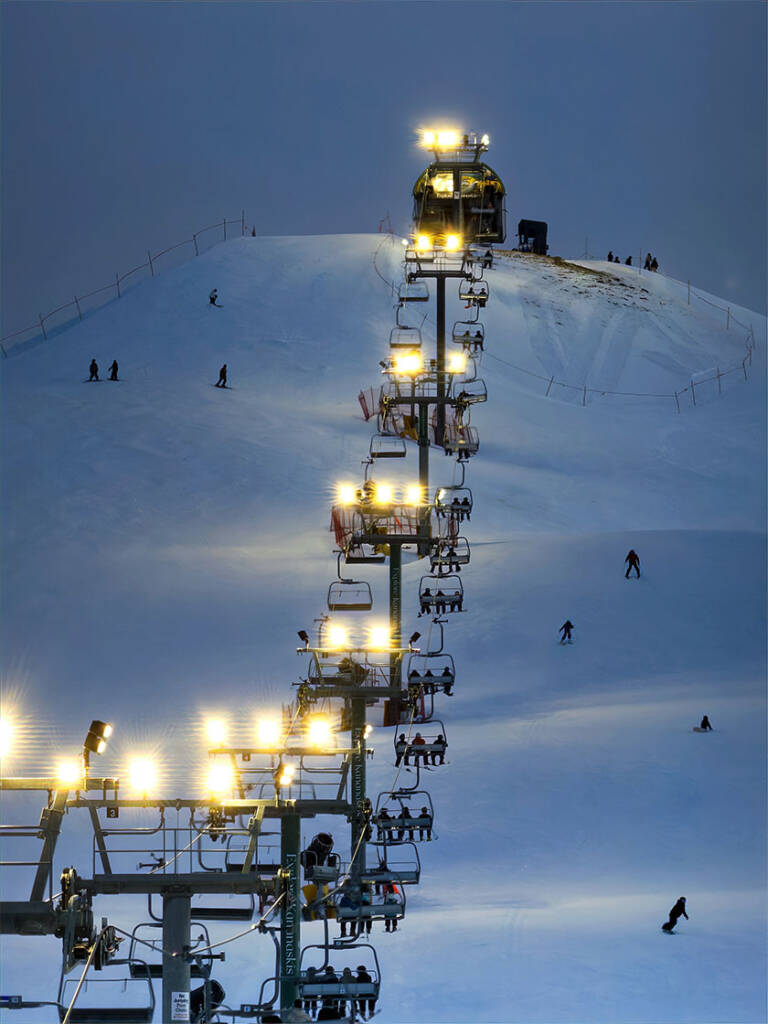
The proposal at the heart of this article is simple to state and transformative in effect: extend the operating model to a 14-hour day, 8 a.m. to 10 p.m., and program the evening hours deliberately. In that expanded day, the mountain becomes five things at once:
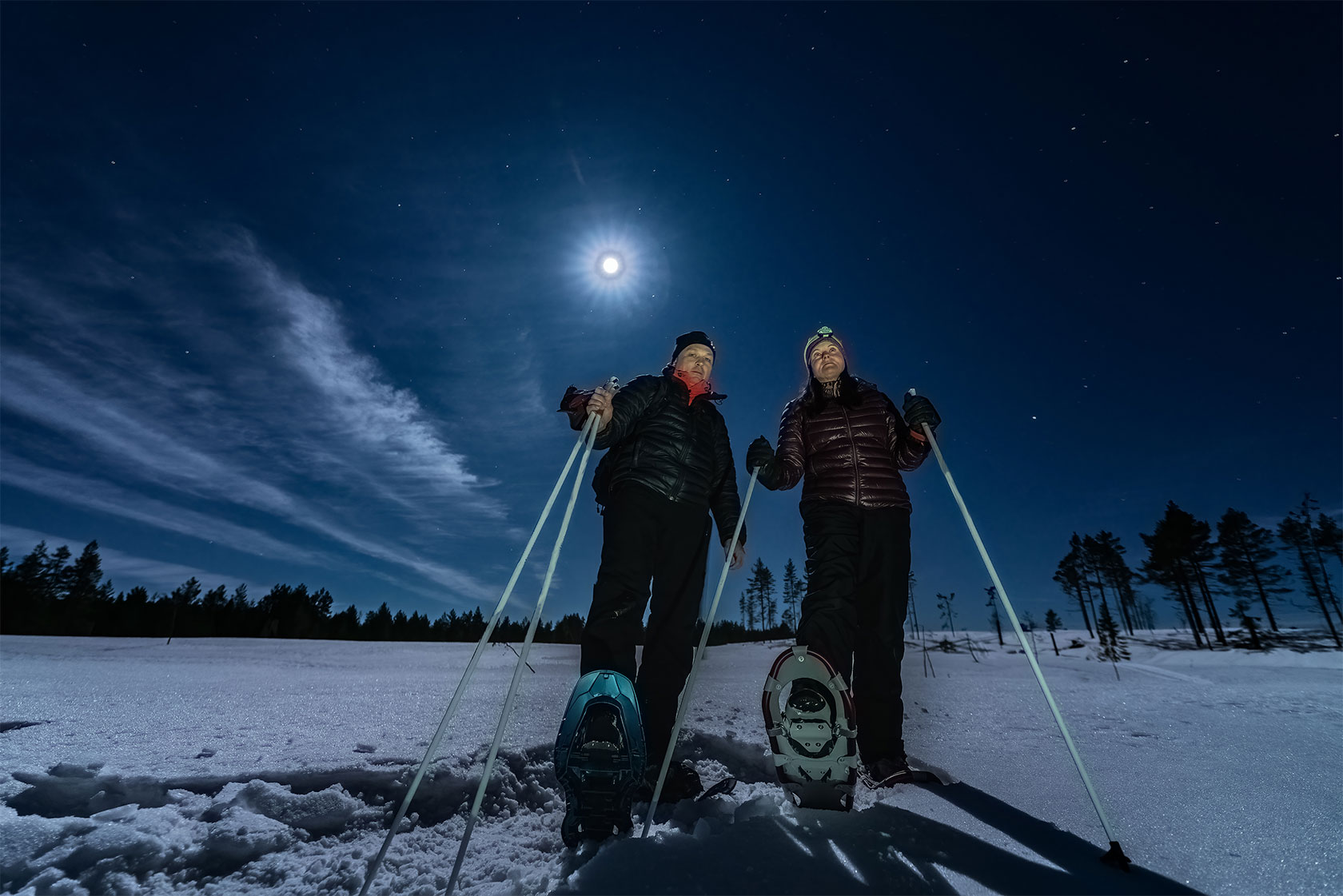
- Recreation: night skiing, riding, tubing and snowshoeing for the general public.
- Education: after-school academies that turn the lodge into a classroom.
- Entertainment: concerts, rail jams, carnivals and social events.
- Wellness: active-aging programs, adaptive skiing and winter fitness.
- Community: a standing gathering place for scouts, veterans, schools and civic groups.
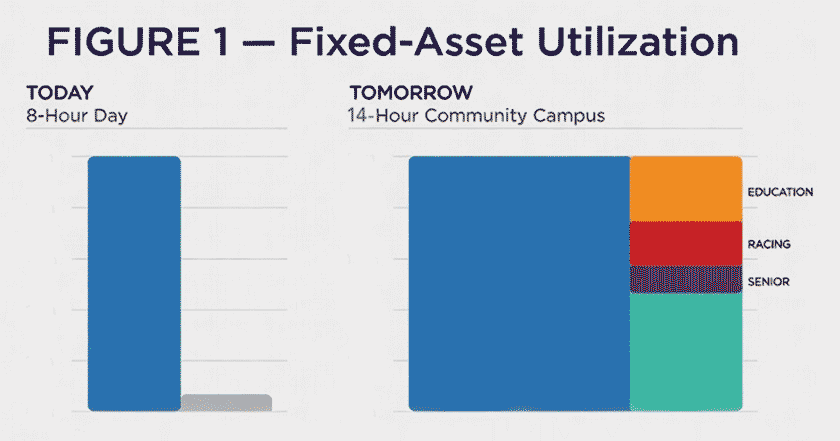
Adding four to five evening hours expands potential access by 40 to 60 percent over the daytime baseline, and does so against a fixed-cost base that has already been paid. The marginal economics of the 14th hour are fundamentally more favorable than the economics of the eighth because the capital is already in the ground.
Part II: What the trends show
The evening opportunity is not a hunch, it sits on top of a decade of industry data. Successive NSAA Economic Analysis and Kottke End-of-Season reports point in a consistent direction, and it is worth reading the trends as a pattern rather than a list of isolated statistics.
Night skiing is already mature where the population math demands it, a core strategy for the substantial majority of southeast and Midwest areas, and adoption has accelerated among large and destination resorts seeking to stretch fixed assets across a longer day.
| Evening | Anchor Program |
|---|---|
| Monday | Adult Learn-to-Ski: low-pressure entry for working adults |
| Tuesday | Middle-School Racing: club and academy gates on dedicated lanes |
| Wednesday | Mountain Academy: after-school academics and on-snow instruction |
| Thursday | Senior Wellness Night: active aging, adaptive, social |
| Friday | Concert / Rail Jam / Singles Night: entertainment and spectator revenue |
| Saturday | U.S. Ski & Snowboard / Freestyle: sanctioned events and competition |
| Sunday | Tubing / Snowshoe Festival / Winter Carnival: family and non-ski recreation |
Underneath that headline, several currents reinforce one another: ancillary (non-ticket) revenue has climbed to record levels per visit, driven by a deepening dependence on food and beverage, tubing has emerged as a powerful non-ski draw that often justifies early-season snowmaking on its own and the broader tourism market has tilted decisively toward experiential travel, where guests buy an evening out rather than merely a lift ticket.
Demographics are shifting too, toward multigenerational visitation, active-aging participants and regional guests who can reach a mountain on a weeknight, but not a workday morning. Read together, these trends describe a market that is ready for exactly what the evening offers: higher-margin, experience-driven, community-anchored programming that does not compete with the daytime skier for prime terrain.
Part III: The mountain as a community campus
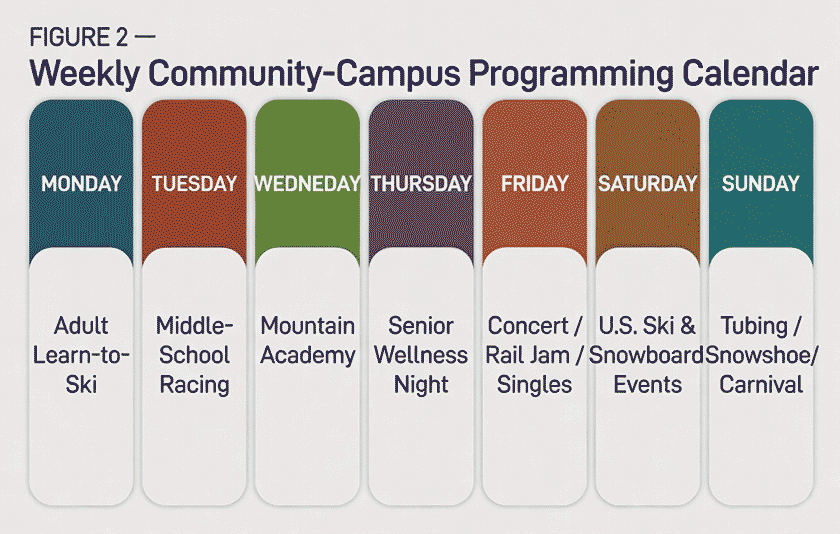
This is the centerpiece. The reframe is to stop thinking ‘ski area’ and start thinking ‘community asset’ that’s open seven days a week, every evening, each night anchored by a program matched to a distinct audience, margin profile and civic purpose. A representative week:
No single night carries the model. Their combination does. Where a passive “lights-on” operation offers the same night skiing every evening and hopes for volume, the community-campus calendar gives every segment of the region a reason to come, and a different reason each night. That is what converts a mountain from a weekend recreation destination into a winter institution.
Part IV: Out-of-school mountain academy
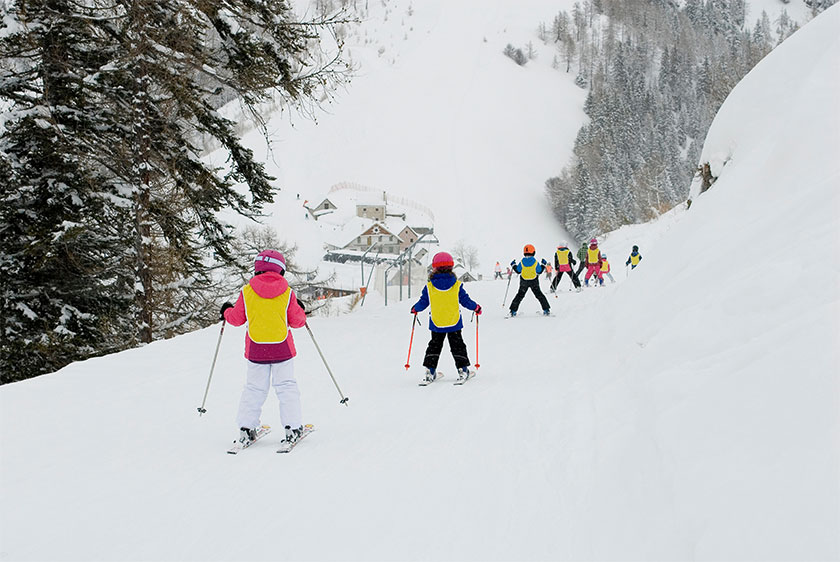
If one section captures the whole idea, it is this one. The lodge becomes an extension of the classroom. Winter’s short school day ends early, parents work until evening, and the gap between the final bell and dinner is precisely the window a mountain sits empty. The Mountain Academy fills it with a structured after-school program that pairs academics with the slopes.
| Time | Activity Block |
|---|---|
| 4 –5:30 p.m. | Academic instruction: math, English, history, geography, STEM, environmental science |
| 5:30 – 8 p.m. | Mountain activities: racing, freestyle, learn-to-ski, snowboarding, Nordic, snowshoeing |
Parents arrive after work to collect children who have finished their homework and spent two hours on snow. Instead of paying for babysitting, the family gains an educational partner and the mountain gains steady weekday-evening visitation from a demographic that rarely skis midday. The concept knits together a region’s schools, its families and its winter recreation asset into a single relationship that recurs all season.
Funding is where discipline matters. Several public and philanthropic programs are designed to support exactly this kind of out-of-school academic enrichment, and they are worth exploring in partnership with school districts, which are typically the eligible applicants rather than the mountain itself:
- 21st century community learning centers ( federal, administered by states)
- State-administered after-school and expanded-learning grants
- STEM-education and environmental-education grant programs
- Local education foundations and community-foundation partnerships
The honest framing for any operator is that these are potential funding pathways to investigate with district and foundation partners, not entitlements; eligibility rules are specific and most flow through schools serving defined populations. Presented that way, the Mountain Academy becomes a credible community-education proposal rather than an overreaching grant claim.
Part V: Active aging on the mountain
At the other end of the demographic curve lies an underserved and rapidly growing market. The frame is not “older skiers” but active aging, a wellness and social category that treats the winter mountain as a setting for health, connection and gentle recreation. It is one of the fastest-emerging trends in the broader tourism economy and the evening is its natural home. A Senior Snow Night program can span a wide range of activity levels and interests:
- Adaptive skiing and guided snowshoe hikes
- Wellness lectures, balance training and winter fitness sessions
- Physical therapy and rehabilitation partnerships
- Social dinners, music and intergenerational “grandparents and grandchildren” nights
The partnership ecosystem is ready-made. Hospitals and physical therapy practices supply expertise and referrals; Area Agencies on Aging, YMCAs and municipal recreation departments supply participants and often program funding, community foundations supply grants. Senior Snow Nights convert quiet weeknights into community goodwill and steady ancillary spend, and they diversify the guest base against the volatility of weather-dependent skier visits.
Part VI: Community partnerships
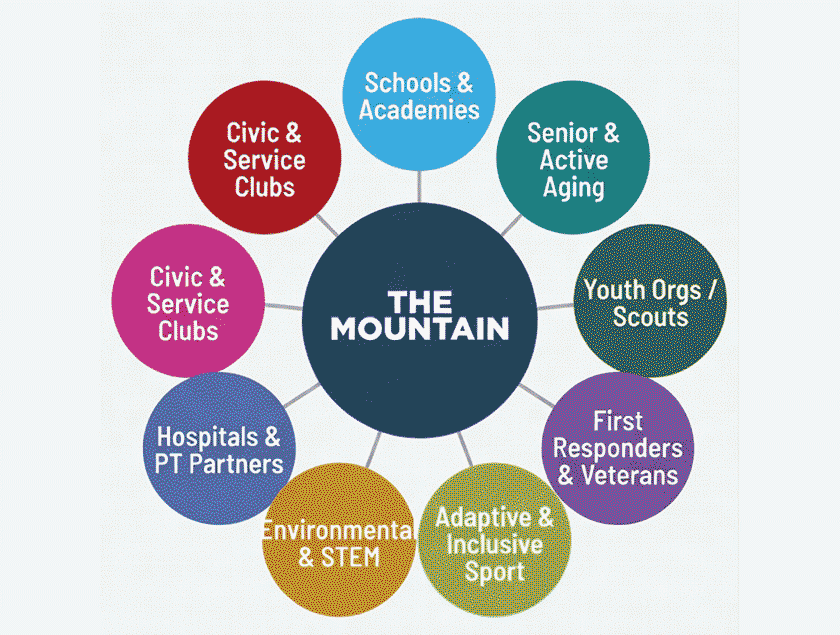
A community campus is defined by the breadth of its partners. Beyond schools and senior organizations, a deliberately programmed mountain becomes a natural venue for a wide range of civic, youth and service groups, each bringing its own members, its own occasions and often its own funding. The evening calendar has room for all of them:
- Youth organizations: Scout troops (Boy Scouts, Girl Scouts), church youth groups, 4-H, STEM clubs
- Service and first responder groups: veterans’ organizations, police, fire departments, EMS appreciation nights
- Education partners: high schools, colleges and universities for club programs, physical education credit and research
- Adaptive and inclusive sport: Special Olympics, adaptive sports associations, therapeutic recreation programs
- Environmental and STEM organizations: conservation groups, nature centers and science education non-profits
Each partnership does triple duty: it fills an evening, it broadens the base of people who consider the mountain “theirs” and it frequently arrives with grant funding, sponsorship or in-kind support attached. The cumulative effect is a mountain woven into the civic life of its region: far more durable than any single marketing campaign and far harder for a competitor to replicate.
Part VII: The revenue model
A community campus strategy requires explicit cost-revenue modeling rather than “lights on, tickets sold” assumptions. The cost drivers are familiar: lift operations, snowmaking and grooming (including interim grooming between day and night sessions), lighting energy and maintenance, food and beverage staffing, security and incremental management overhead.
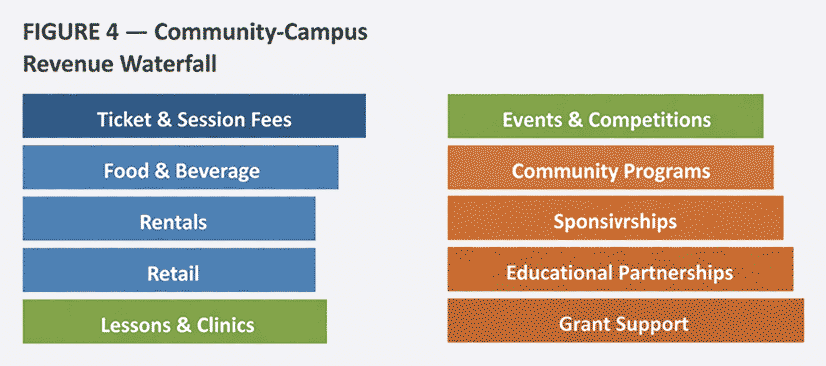
What changes on the revenue side is the sheer number of streams. Where a traditional night operation sells tickets and food, the community campus layers program fees, lane rentals, community and education partnerships, sponsorships and grant support on top. The most useful way to picture the model is as a revenue waterfall with each layer stacking onto the last, and the later, community-driven layers carrying the highest margins and the greatest durability:
The illustrative model below carries the same three-scenario structure a mid-size area should build with its own numbers, now with a community and education line reflecting the expanded strategy. Even under conservative assumptions, the evening clears a positive contribution margin; under the base case, it becomes a meaningful profit center.
| Metric (per evening) | Conservative | Conservative | Optimistic |
|---|---|---|---|
| Night tickets / session fees | $2,400 | $4,800 | $7,200 |
| Lane / terrain rentals | $600 | $1,500 | $3,000 |
| Event / program fees | $800 | $2,000 | $4,000 |
| Community and education programs | $500 | $1,400 | $2,600 |
| Food and beverage, retail and rentals | $1,200 | $2,800 | $4,500 |
| Gross night revenue | $5,500 | $12,500 | $21,300 |
| Incremental operating costs | ($3,200) | ($4,500) | ($6,000) |
| Contribution margin | $2,300 | $8,000 | $15,300 |
Part VIII: The enabler, not the strategy
Only now, near the end, does lighting enter and that placement is the point. Lighting is not the strategy. Lighting enables the strategy. None of the programming above exists without safe, uniform, comfortable illumination of the slopes, and the quality of that light shapes both the cost line and the guest experience.
Modern magnetic-induction systems, such as the Snow-Bright™ class, deliver superior uniformity, reduced glare, lower energy consumption, and markedly longer lamp life than legacy metal-halide or high-pressure-sodium installations. As induction lamps render the slope evenly and with less flat-light fatigue, the evening product simply looks and skis better, which matters when guests are deciding whether the night session is worth the trip. In the revenue model, lighting sits on the cost side, but the right lighting lowers that cost while raising the experience quality on which every program depends.
Two operational realities deserve early attention. First, the fully loaded cost of keeping selected lifts and lighting running for four to five evening hours must be modeled honestly. It is the denominator against which every night-revenue scenario is judged. Second, environmental and permitting constraints such as U.S. Forest Service requirements, local zoning, homeowner associations and dark-sky considerations, must be evaluated early, since areas near sensitive habitats or residential zones face higher hurdles and longer timelines.
Efficient, well-directed, low-spill lighting is frequently what makes the permit achievable in the first place. In that sense, lighting is not merely an operating-cost decision, it is often the gating technology that determines whether the community campus can be built at all.
The clearest evidence that the technology can carry an evening strategy comes not from a manufacturer’s brochure, but from the trade press and the operators themselves. Two industry publications – the NSAA Journal and Ski Area Management (SAM) – independently documented the same installation in the winter of 2014, and the operator has since reported the revenue results.
The winter “third place”
Sociologists describe a “third place” as the space beyond home and work, or home and school, where a community gathers, connects and belongs. For a winter region, the mountain is uniquely suited to become that place. Not a ski area open until 4 p.m., but a community campus running until 10 p.m.: a classroom on Wednesday, a wellness center on Thursday, a concert hall on Friday, a stadium on Saturday, a family carnival on Sunday.
The industry has spent decades asking how to sell more lift tickets. The larger, more compelling question is what business the mountain can become after sunset, and the answer is a community-centered, multi-use destination that serves recreation, education, entertainment, wellness and civic life across a 14-hour day.
Night skiing was never the destination. It was the first hint of what the mountain could be once the sun goes down. The operators who see that will not merely add evening hours, they will transform a seasonal recreation asset into the enduring center of their community’s winter.
Philip Gotthelf is managing director of Ultra-Tech Lighting LLC, a manufacturer of modernized magnetic induction lighting whose Snow-Bright™ line is engineered for ski and snow venues. He has worked on energy conservation since 1978, and on lighting specifically since the early 1980s. Gotthelf also founded EQUIDEX Energy, LLC, an energy auditing firm with snow sports venue experience. He is a Lehigh-trained economist and the author of Precious Metals Trading and Currency Trading (John Wiley & Sons), and has commented on energy markets for Bloomberg, CNBC and FOX Business, a background that informs this article’s asset-utilization analysis.