Any alpine skier is familiar with snowmaking and knows it is vital for resorts and surrounding communities to sell tickets, meals and beverages, fill beds, provide jobs, generate taxes and much more.
Snowmaking is less common at cross-country (XC) areas in the U.S. and Canada, although it is present at roughly 70 sites, with the number increasing each year. The most extensive XC systems are generally at venues hosting World Cup and Olympic races such as Soldier Hollow in Utah, Canmore in Alberta, Mt. Van Hoevenberg in New York and Whistler Olympic Park in British Columbia.
Other Nordic operations have made major investments in snowmaking, including Ariens Nordic, MadNorSki and the Birkebeiner trails in Wisconsin, Forbush Corner in Michigan, Tahoe Donner in California, several private schools and colleges with XC teams in New England and clubs like Caledonia Nordic in British Columbia, Bridger Ski Foundation in Montana and Nakkertok Nordic in Quebec.
Curiously, few XC operations owned by alpine ski areas have added substantial snowmaking.
Evolution of XC snow farming
Once upon a time, snow farming in the XC ski world meant doing what you could to keep whatever falls from the sky. In the early 1970s, when trail design and maintenance practices were still developing, snow farming often involved simple, logical and ongoing measures that required significant time and labor. These generally included routing trails to optimize snowfall, removing protruding rocks, trimming overhanging conifers and cleaning debris from trails after storms.
A few sophisticated venues improved trail surfaces with grass or wood chips and installed snow fencing to capture wind-created drifts that could later be redistributed. Operators also mitigated wet areas where melting and ice were concerns by rerouting trails, installing culverts and adding fill when possible. Bridges were often built with railings and kickboards to prevent snow from bleeding off edges while allowing meltwater to drain away. Encroaching brush was removed and snow was sometimes shoveled directly onto the trails.
Grooming crews also learned the value of packing and “age-hardening” snow through machine-grooming it from the moment it fell. In the West, the drought winter of 1976–77 and another miserable season in 1980–81 made the industry more conscious of weather vulnerability. By then, Eastern and Midwestern operations in the U.S. and Canada understood once-predictable winters would be interspersed with periods of melt.
XC snowmaking
Over the years, XC snow-saving technology has evolved to include man-made snow. The earliest snowmaking Wiesel recalls was Weston Ski Track in the mid-1970s (they are still going strong), on a golf course near Boston.
There were some additional areas, but Nordic snowmaking has become relatively frequent only in the past dozen years or so. Olympic sites seem to be the primary exception, with Canmore Nordic Centre probably the earliest, around 1988, and Soldier Hollow in 2002.
Several of these sites include professionally designed trails with snowmaking. Trail planner John Morton of Morton Trails in Vermont has often combined the two. Some of Morton’s projects are Ariens Nordic, Rikert Ski Touring Center (Middlebury College), Vt., Dartmouth College in Oak Hill, N.H., Dublin School, N.H., and Kents Hill School, Maine. Snowmaking companies increasingly see XC as a significant, if smaller-than-alpine market.
The next step: Keeping what you get
The basic principle is that when there’s enough snow (preferably man-made because of its density/longevity), the priority is to coddle it. Rain, sunshine, warm temperatures and especially wind can wreak havoc on piles of snow that could otherwise prolong the ski season.
Roughly 20 years ago, XC operators in Europe – especially those involved with early-season high-level races – started using wood chips and sawdust to preserve snow throughout the summer. This often meant that you could open some trails when your neighbors were still sighing about the weather. Craftsbury Nordic in Vermont, Canmore Nordic Centre in Alberta and Whistler Olympic Park in British Columbia have used wood products to protect piled man-made snow between closing in the spring and opening in the fall.
Rain, sunshine, warm temperatures and especially wind can wreak havoc on piles of snow that could otherwise prolong the ski season. The three goals of starting operations on an early, predicted date are hosting events, providing on-snow training opportunities for individuals and teams, and drawing recreational skiers. This timing can be vital to both ski operations and their local economies.
The three goals of starting operations on an early, predicted date are hosting events, providing on-snow training opportunities for individuals and teams, and drawing recreational skiers. This timing can be vital to both ski operations and their local economies.
Most International Ski and Snowboard Federation and International Biathlon Union XC race venues already use wood chips and/or sawdust. Chips a couple of feet deep insulate very well (summer loss is as little as 12%), but they have several drawbacks – rising cost, limited longevity, disposal, dust and debris rising to the surface, separation from snow in the fall, acidifying soil, leaching runoff, etc.
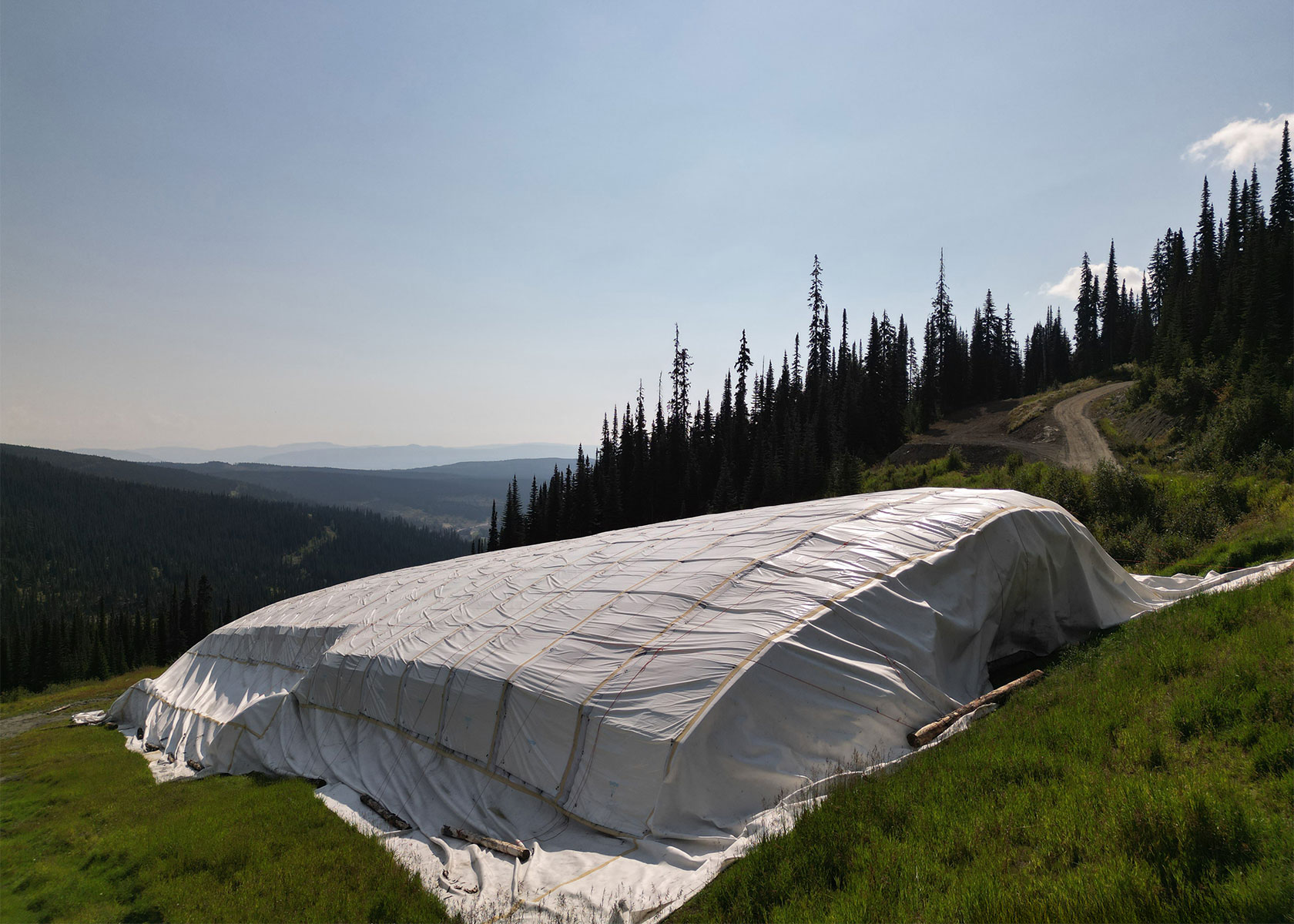
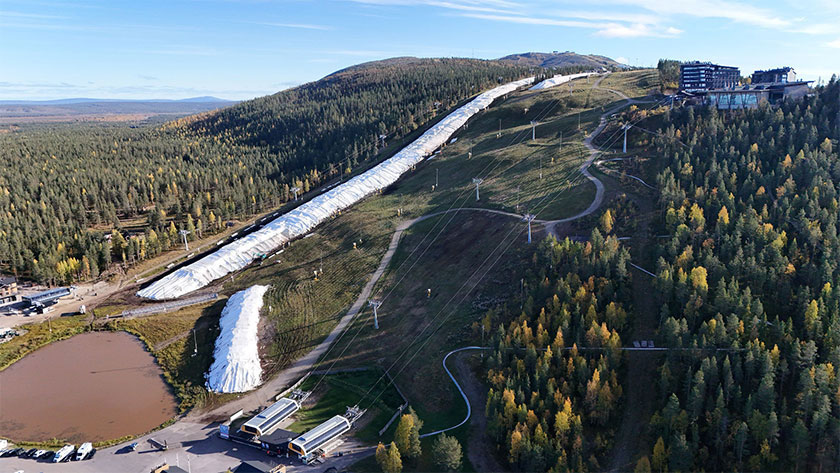
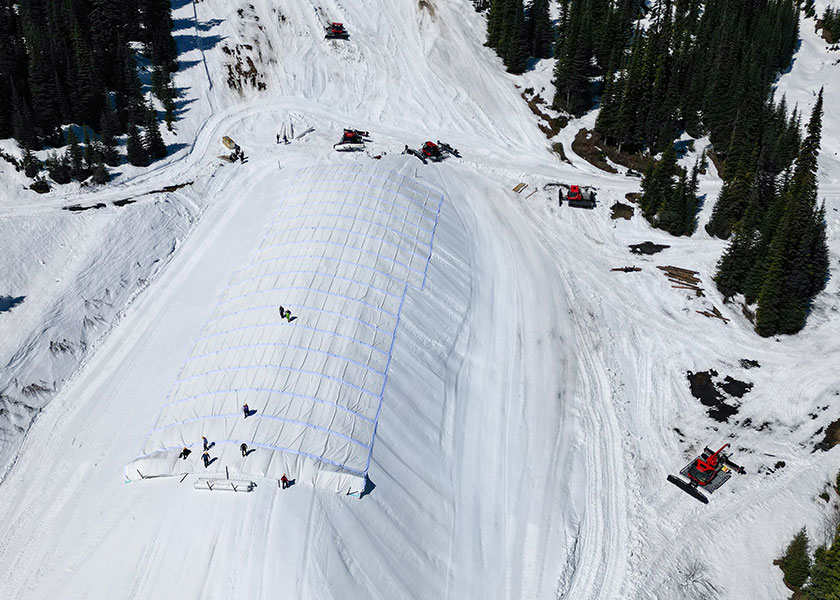
A Finnish company, Snow Secure, has developed white extruded polystyrene blankets that are now used in Europe for both alpine and XC skiing and that have been heralded for their resilience and sustainability. Snow Secure is being introduced to XC areas in both the U.S. and Canada, with Soldier Hollow in Utah as the first to try it out. Currently, they are working with four alpine resorts in North America, including Sun Peaks in British Columbia and Bogus Basin in Idaho.
Shapes for snow piles are tailored to the site. Ideally, the snow piles are made when temperatures are coldest in winter, providing dramatic savings in water and energy use compared to snowmaking in the fall, which is packed into layers and covered with foam mats. At the XC World Cup venue Ruka in Finland, there are three piles configured like bread loaves, each about the size of a football field – around 220 feet by 110 feet by 25 feet high and formidable looking. That’s about 14,000 cubic meters of snow when produced in the winter.
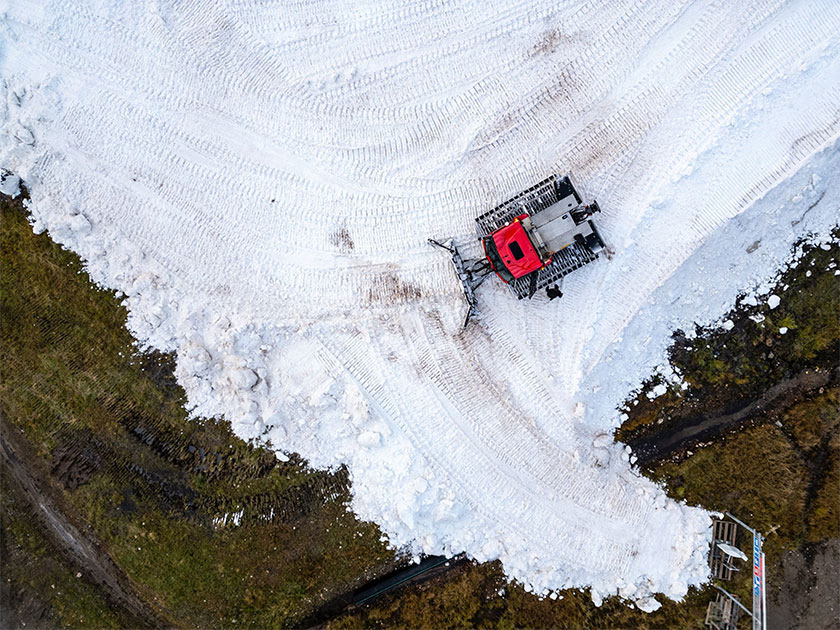
It generally becomes much denser while stored, approximately 10,000 cubic meters, by the time it’s uncovered in autumn. When spread out in the fall, this can translate into roughly three kilometers of trails covered by one foot of snow by 20 feet wide. These synthetics provide effective insulation even at temperatures as warm as 100 degrees Fahrenheit, even in venues such as Ruka Ski Resort in Finland that have perpetual summer daylight.
Their stored snow is good quality for spreading, grooming and skiing, although the system is not quite as efficient as wood chips for preserving snow. The materials are durable and long-lived (more than a decade). Installation and uncovering the snow is swift and simple, then it’s spread. Unlike wood products, the materials can be collected and routed to recycling or energy recovery.
The future of snow storage
Complexities include cost, finding a convenient summer location for the piled snow and winter storage of the insulating materials. But the word is getting out that there’s an option to losing vital parts of early-season operations. In the next few years, there might be at least a half-dozen more North American XC areas – more and sooner for alpine resorts – that adopt snow storage as a case of “can’t live without it.”
This article was originally published on Jan. 19, 2026 at SeniorsSkiing.com and is reprinted here with permission.