Ski resorts operate in environments where terrain conditions change constantly – from early-season soft ground and thin snow cover to spring melt and summer trail work. In these situations, maintaining access roads, service routes and ski trails can be difficult when conventional graders equipped with pneumatic tires struggle to maintain traction or begin to sink into soft ground.
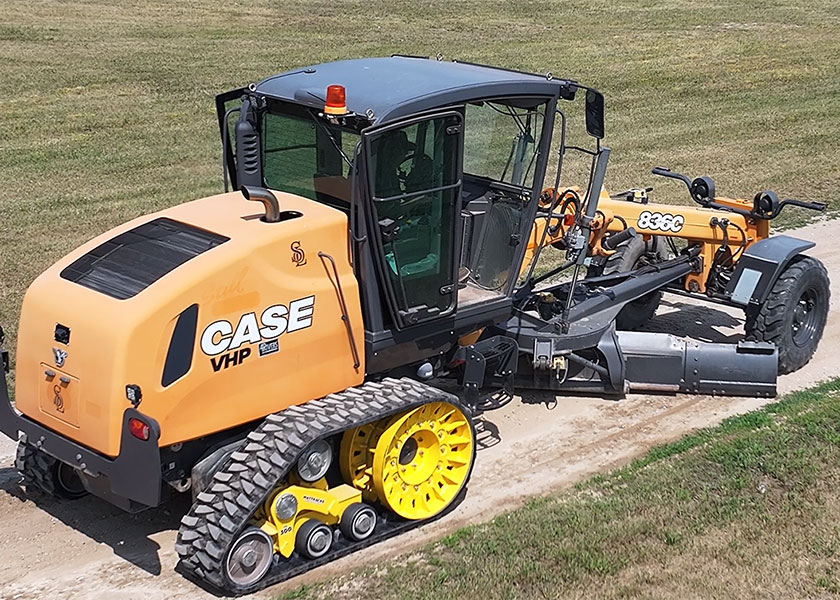
Mattracks has introduced a breakthrough solution that redefines what road graders can accomplish: the TD300 Tandem Drive heavy-duty rubber track conversion system engineered specifically for road graders operating where tires fail and steel tracks fall short.
Designed for soft, sandy and unstable terrain, the TD300 Tandem Drive grader track system enables full grading capability in environments where wheeled machines typically stall. With a current gross vehicle weight rating of 30,000 pounds (lbs). and engineering capability extending beyond 40,000 lbs for larger platforms, the system opens new operational territory for construction, infrastructure, energy, mining and military support operations.
The TD300 could help address ski areas’ challenges by increasing the grader’s ground contact area and improving flotation on loose or unstable surfaces.
Built because the job couldn’t wait
The TD300 system was developed in response to a real-world challenge. A customer approached Mattracks needing to grade sandy desert terrain where pneumatic tires repeatedly sank, stalled production and compromised surface quality. No viable off-the-shelf solution existed.
Rather than avoid the application, Mattracks engineered one. The result is the TD300 Tandem Drive rubber track conversion, built for road graders, adapting proven industrial track technology to a machine category few manufacturers have attempted.
A Tandem Drive track system engineered differently, on purpose
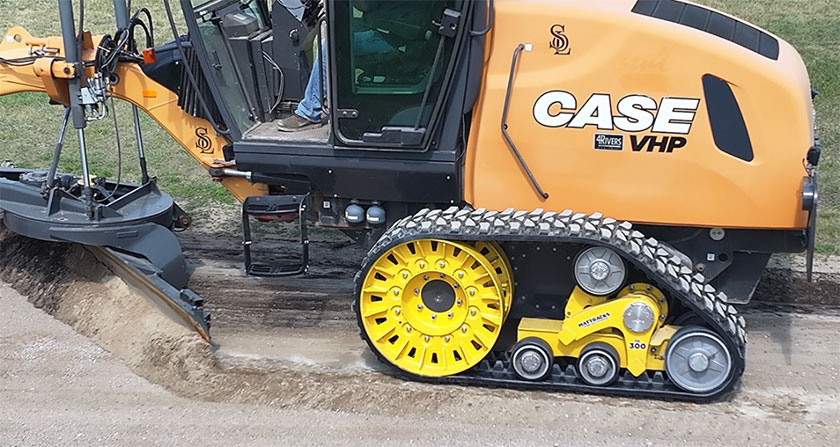
Unlike conventional track designs, the TD300 Tandem Drive system uses a floating bearing, hub-mounted drive architecture, a configuration rarely used in track systems and not previously applied at this scale for graders.
This design:
- Drives the track from a single axle, eliminating torsional stress and track folding
- Distributes load across both drive axles for improved stability and balance
- Maintains a true hub-mounted, plug-and-play installation
- Preserves grader geometry while dramatically increasing ground contact area
“For grading, flotation and consistency matter more than obstacle clearance,” said Jon Vacura, engineer at Mattracks. “The goal isn’t climbing, it’s staying level, maintaining traction and producing a uniform surface. Increasing the footprint directly supports that.”
Smoother grading by eliminating tire bounce
Beyond flotation and traction, the TD300 addresses another long-standing challenge in grading operations: surface inconsistency caused by pneumatic tire bounce that results in a washboard road. The very condition a grader is designed to eliminate.
Pneumatic tires react to surface depressions by compressing and rebounding. This repeated compression introduces oscillation into the machine, which transfers directly to the blade. The result is uneven grading, reduced surface quality and operators being forced to slow down to maintain acceptable results, ultimately impacting productivity.
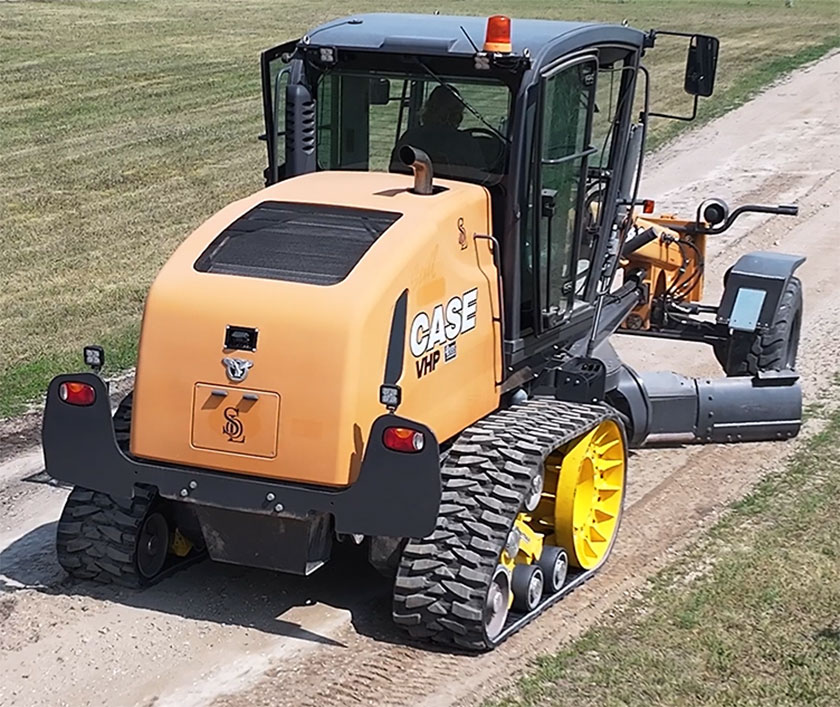
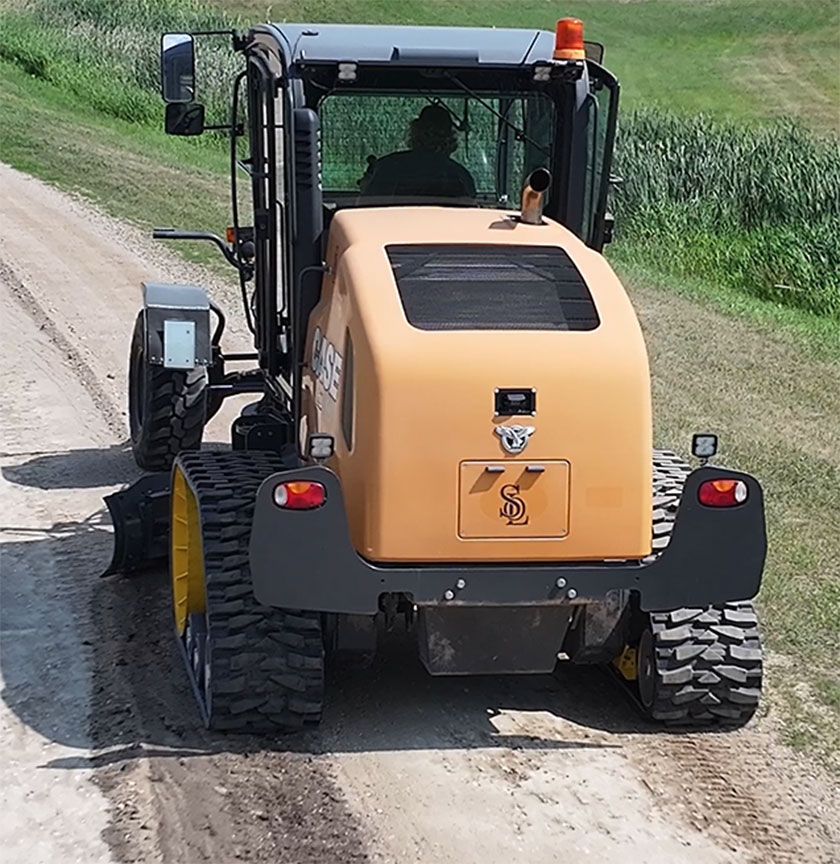
Rubber tracks, by contrast, span surface depressions rather than dropping into them. This allows the grader to maintain a more consistent ride height, delivering smoother blade control and a more uniform finished surface.
“In grading, the machine is actively flattening the surface,” said Vacura. “Tracks span depressions instead of reacting to them, which helps maintain a consistent grade and reduces the need to slow down to control bounce.”
Surface quality is also important for ski areas maintaining gravel access roads, service routes and mountain infrastructure corridors. Because rubber tracks span depressions rather than dropping into them like pneumatic tires, graders equipped with a track system can maintain a more consistent ride height and blade control. The result can be a smoother finished surface with less of the washboard effect that often develops when tire bounce transfers vibration to the blade.
Real gains where it matters most
Operators using the TD300 Tandem Drive system can expect immediate advantages, including:
- Substantially improved flotation and traction in sand, loose soil and soft ground
- Reduced surface disturbance compared to tires or steel tracks
- Smoother grading results due to reduced machine bounce
- Extended work windows after rain or in sensitive terrain
- Lower downtime and fewer recovery delays
- Improved access and schedule reliability
Rubber tracks also offer environmental benefits over steel alternatives, delivering controlled compaction and significantly lower ground pressure, critical for solar installations, infrastructure corridors and protected areas.
The increased flotation and traction provided by rubber tracks may also help extend the working window for resort maintenance crews. During shoulder seasons, when thawing ground or wet conditions can limit equipment mobility, a larger footprint and lower ground pressure can help graders continue operating without becoming stuck or causing excessive surface damage.
During shoulder seasons, when thawing ground or wet conditions can limit equipment mobility, a larger footprint and lower ground pressure can help graders continue operating without becoming stuck or causing excessive surface damage.
Lower ground pressure and reduced surface disturbance can also be beneficial in sensitive mountain environments. For resorts managing extensive trail networks and infrastructure corridors for lifts, utilities and summer recreation, equipment that minimizes soil disruption while still providing effective grading performance can support ongoing maintenance that protects the surrounding terrain.
Built to last. Engineered with purpose.
As with all Mattracks systems, durability is engineered into the TD300 design. These industrial track systems are designed for long-term service when properly maintained, with preventive maintenance focused on track tension and storage practices. Safety and reliability are incorporated at every stage of design and production.
“Our focus is on solving the mechanical problem correctly,” said Vacura. “That means designing for the loads involved, choosing materials that hold up in real conditions and making sure the system performs the way operators expect it to.”
Designed for customization, backed by real support
While the TD300 was developed for a midsize grader platform, Mattracks has already quoted solutions for larger graders, including machines exceeding 40,000 lbs.
Customization remains a core capability. If a configuration is feasible, Mattracks will engineer it. If it’s not, the company will say so, clearly and directly. Installation is straightforward thanks to the hub-mounted Tandem Drive design, and Mattracks’ in-house service team is available by phone to support customers during installation and operation.
“After more than three decades in business, we still believe support matters,” Vacura said. “When someone calls, they’re talking to people who understand the product and the application.”