Avalanche mitigation has always required a difficult balance between risk and responsibility. Before ski resorts and highways can safely reopen to the public, avalanche professionals often have to enter dangerous terrain to make it secure for everyone else.
For decades this work has relied on tools such as hand charges, helicopters, fixed remote avalanche control systems, gas exploders and even military artillery. These methods remain essential parts of avalanche programs, but they also come with serious exposure for the people doing the work.
Patrollers may need to ski or hike into avalanche terrain to deploy charges by hand. Helicopter crews may be asked to fly in without much warning into complicated mountain weather. Transportation agencies may need to manage long avalanche paths that threaten highways, but it is not always practical to install permanent avalanche-control equipment.
Drone Amplified believes robotics can help change all that.
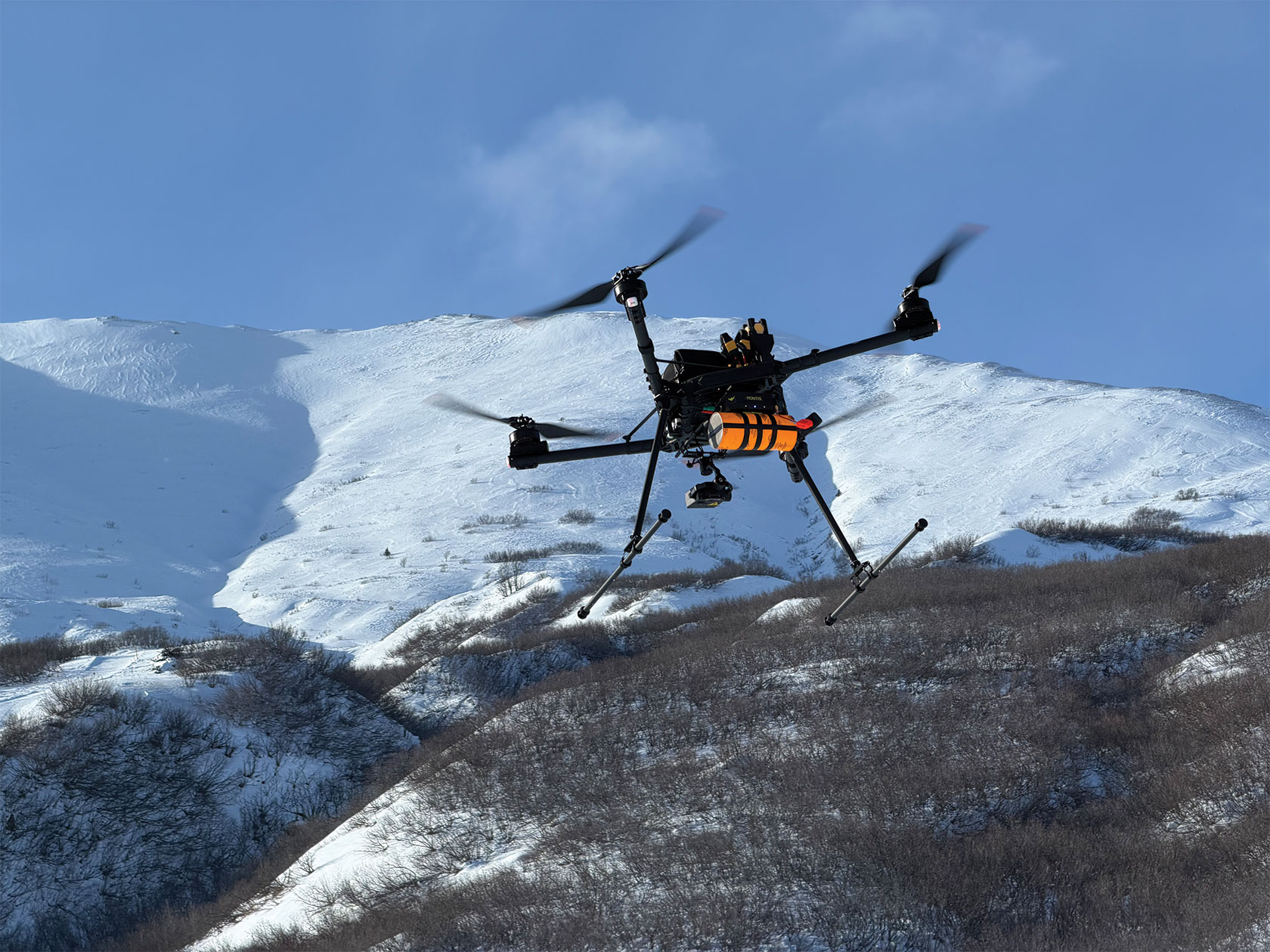
The Nebraska-based company has developed MONTIS, a commercial-grade uncrewed aerial system designed for avalanche mitigation. The system allows operators to fly a drone into high-risk alpine areas, deploy explosive payloads and initiate controlled avalanches from a safe, remote position.
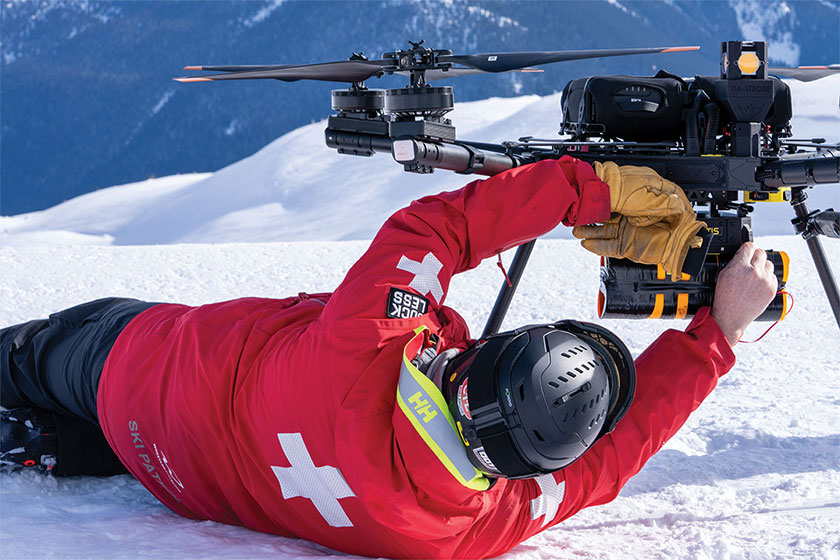
“MONTIS is a fully-integrated, commercial-grade uncrewed aerial system designed to modernize avalanche mitigation,” said Paul Fletcher, technical product lead at Drone Amplified. “It is designed to fundamentally change the safety equation by removing the human element from the physical danger zone.”
Fletcher stressed that MONTIS is not intended to replace avalanche professionals or eliminate the need for existing mitigation tools, but instead give experienced teams another option. Avalanche mitigation is site-specific, weather-dependent and highly technical so no single tool is appropriate for every path or storm cycle. However, drones may be able to fill a gap for terrain that is dangerous or difficult to reach.
Fletcher says an electronic ignition system is the heart of the system and goes beyond older approaches such as physical pull-fuses and impact-based charges. In a typical mission, the operator flies the drone to a predetermined location, deploys the explosive charge and uses custom software to trigger the blast at a specific height above the snowpack. The goal is to create an airblast rather than allowing the charge to hit the snow surface and bury itself. By detonating the charge above the snowpack, the system can spread energy more effectively across the target zone.
The system’s recent field testing in Alaska provided an important case study. Fletcher says the Alaska Department of Transportation executed hundreds of drops during the testing process, giving Drone Amplified an opportunity to validate its electronic ignition system in severe alpine conditions. These tests also helped the company determine whether batteries can work for field crews in severe winter conditions.
“Early on we realized how quickly the bitter Alaskan cold impacted power levels, leading us to develop custom battery ‘koozies,’ or insulation pouches, to keep the drone’s batteries warm enough to operate reliably,” Fletcher said.
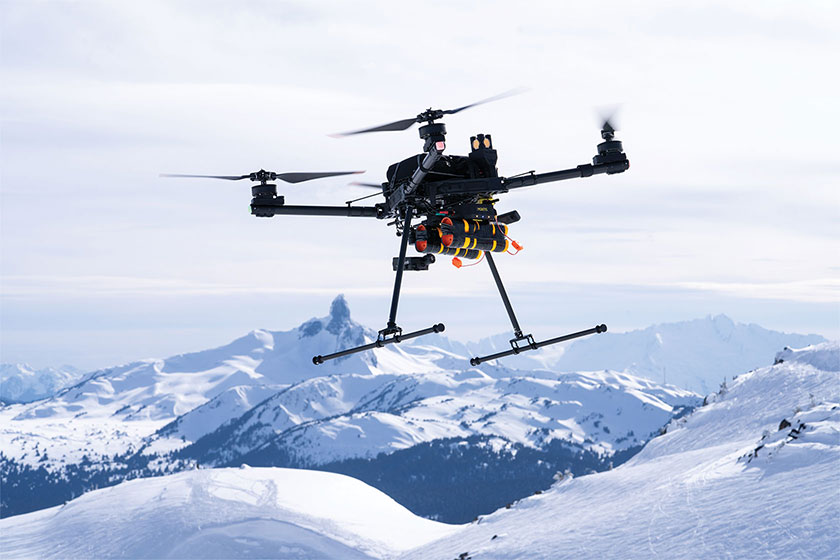
MONTIS is designed for highly-exposed, steep avalanche paths, hard-to-reach cornices and critical transportation corridors. Fletcher says it can be used for planned control work before a resort opens, as well as emergency situations.
The drone is built for heavy-lift operations and cold mountain environments, but it still suffers from the same constraints that affect other aerial tools. The system requires visual line-of-sight, and it is not intended to fly in severe whiteout conditions or high winds. The system is equipped with GPS, 4K zoom cameras, radiometric thermal imagers and laser rangefinders. MONTIS also records flight and drop histories, allowing teams to compare results over time.
“Operators can look back at the data and say, ‘Last year with this weather, we dropped a one kilogram charge right here and got a great slide,’” Fletcher said. “This historical repeatability ensures highly-efficient airblasts that often allow us to use smaller, less expensive explosives to achieve the exact same effect as the much larger payloads that are traditionally fired from military howitzers.”
Some of the highest-risk work involves sending people directly to dangerous terrain to throw charges by hand. Helicopter-based mitigation can reduce some ground exposure, but it still comes with its own set of risks. MONTIS eliminates these risks by allowing crews to operate from a secure, remote location.
Since the system involves explosives, safety redundancies are built into the process. Fletcher says that a charge should only detonate exactly when and where it is intended. Unlike traditional pull-wire or impact systems, MONTIS maintains communication with the ignition system so the operator can check the charge’s health and status before the final fire command is issued.
The software also uses a strict “geofence.” The operator cannot arm the charge until the drone has entered the approved deployment zone. If the drone leaves the predefined area, the payload automatically disarms. Operators can also monitor the drop and manually disarm the system mid-flight if conditions change.
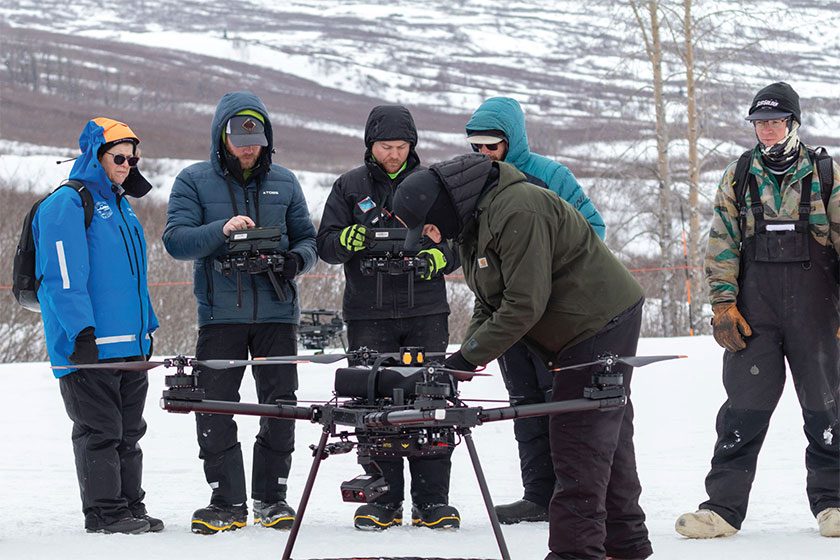
Although the technology is advancing quickly, regulation remains one of the barriers to wider adoption. The United States Federal Aviation Administration (FAA) regulates drone operations, especially when a payload attached to an uncrewed aircraft could be classified as a dangerous weapon. Fletcher says Drone Amplified has previous experience with this regulatory environment since its wildland firefighting system, IGNIS, also falls under the FAA’s dangerous weapon classification.
The successful Alaskan testing is helping to open doors in Canada for the company’s partner, Alpine Solutions. Fletcher says the team received authorization from Transport Canada and completed what he describes as the first-known, drone initiated explosive avalanche mitigation missions at Whistler Blackcomb in British Columbia.
He says that while fixed remote avalanche control systems will remain valuable, especially in known high-risk paths where permanent infrastructure is justified, MONTIS offers a more affordable option in some cases. The system starts at around $125,000 and offers an alternative for paths that do not justify a fixed installation. It also serves as a backup when fixed systems are down or a safer option than hand charges in dangerous terrain is needed.
“MONTIS is a versatile tool that fills the operational gap between ground crews and helicopters,” Fletcher said.
Training will be another important factor in its adoption. Drone Amplified expects operating agencies to use their own personnel, but those personnel must be proficient drone pilots. The company provides training for flight operations, proprietary software, safety procedures and maintenance.
Fletcher says he expects robotics to become a standard part of mountain operations. As drones improve, they may fly longer, perform better in difficult weather and integrate with mapping, snowpack analysis and forecasting tools. That could make avalanche mitigation more repeatable, data-informed and predictable over time.
“Robotics are poised to modernize a legacy process that still relies heavily on military artillery,” he said. “Over the next decade, drone systems like MONTIS will become a standard tool to remove human operators from high-risk environments.”